

LINEFEEDER · DIVIDERS IN TUBE STACKING
A divider on every row of tubes, at the stacker’s own pace.
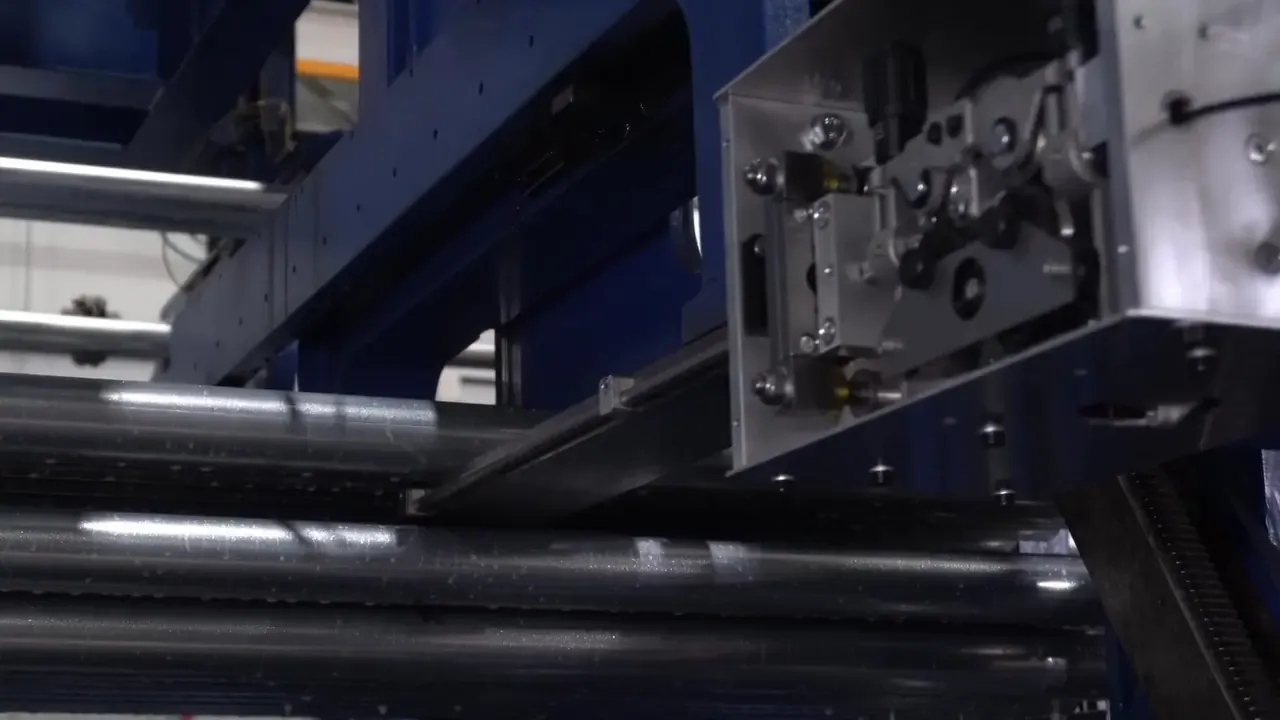
LineFeeder mounts on the stacker you already have. It feeds nylon line from a spool, cuts it to the width of the row and places it while the bundle is built. No one stands in the stacking zone, and the tubes reach your customer without white rust.
Patented mechanism · Greek patent GR 1011084 · International application WO 2026/154276
Measured by ELASTRON on its own lines.
THE PROBLEM
Rust starts inside the bundle.
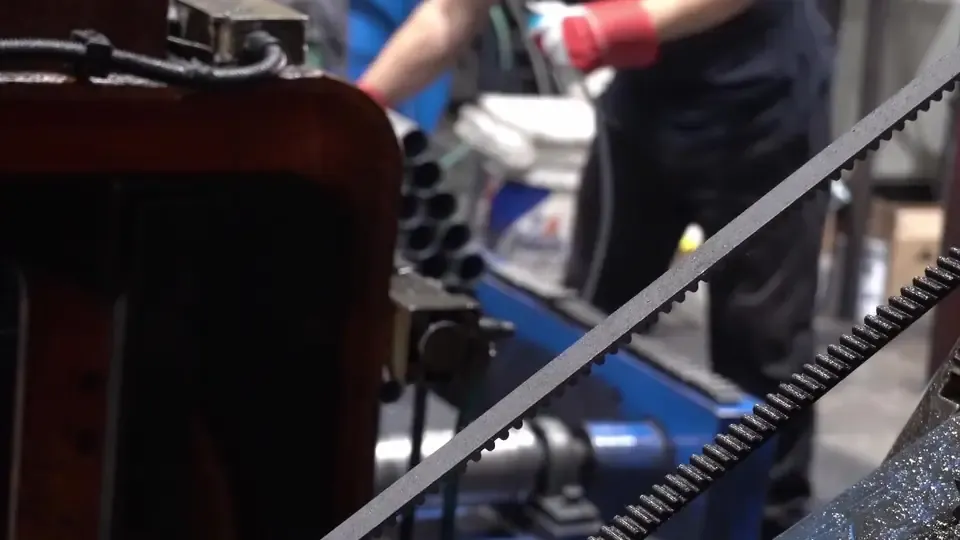
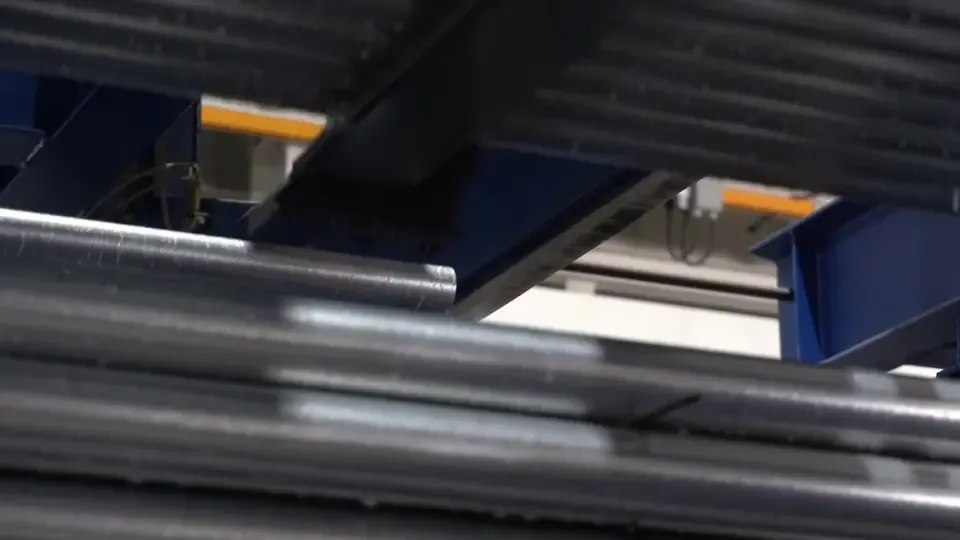
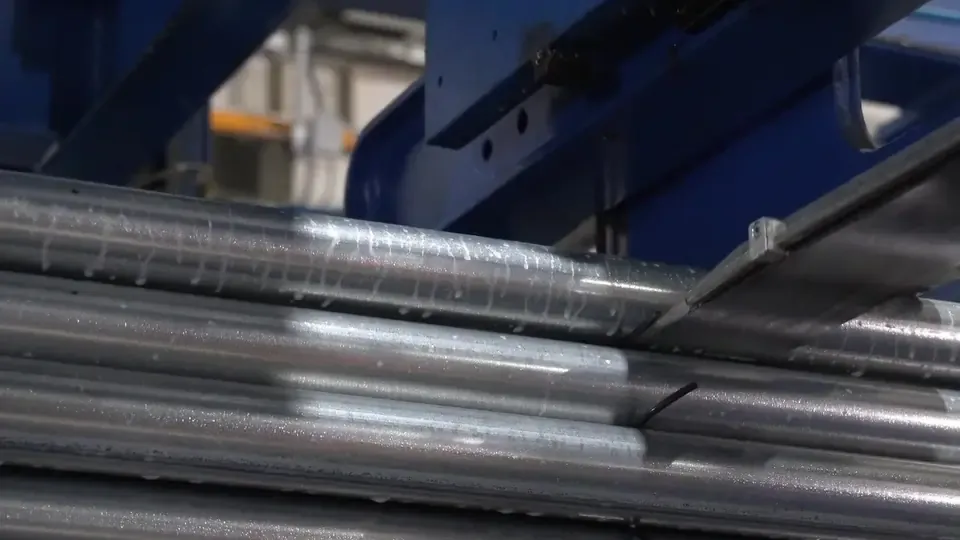
Tube mills cool and lubricate steel with water-based fluids. When pre-galvanised tubes are stacked metal on metal, the moisture cannot leave. White rust appears before the tube reaches the customer: rejected deliveries, claims and rework.
The usual answer is people. Two operators per shift reach into a zone that stacks automatically and fast, and place a spacer on every row. The work is dangerous and uneven, and it sets the speed of the line.
From 20 January 2027 the Machinery Regulation (EU) 2023/1230 applies in place of the Machinery Directive. It is a good moment to take people out of the stacking zone.
THE MACHINE
Feed, measure, cut, place.
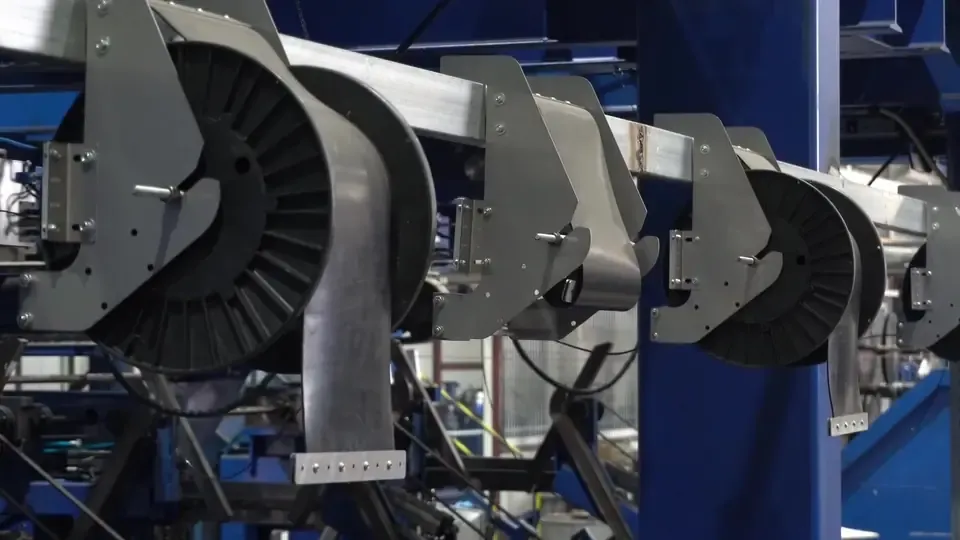
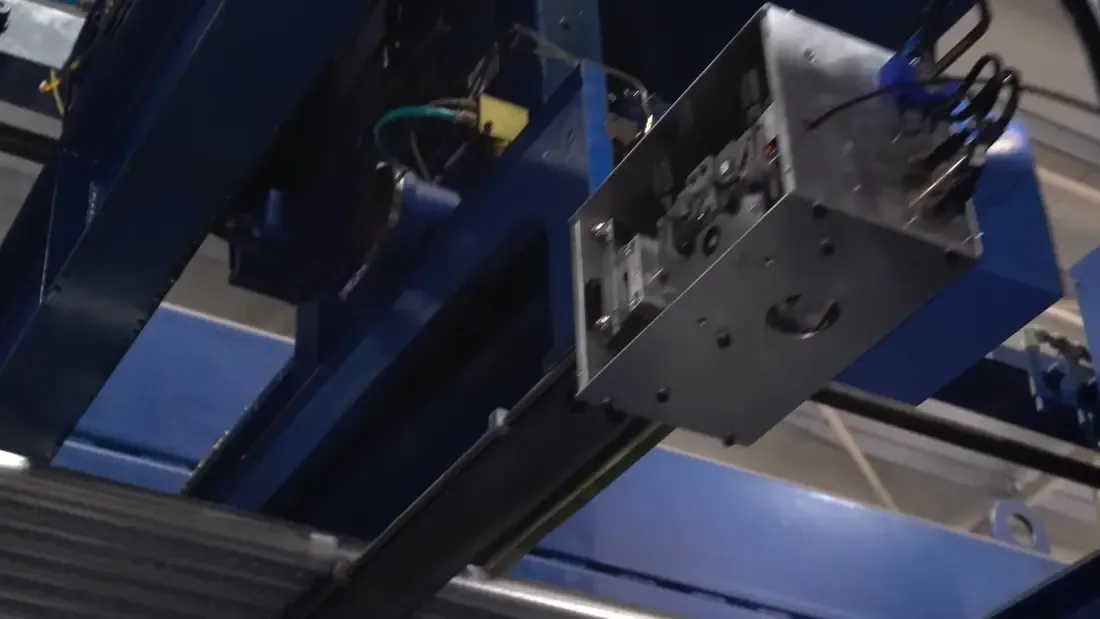
One head does four things on every row. A system has four heads along the length of the tube, a control cabinet and software that talks to the stacker’s PLC.
Feed
The spool holds kilometres of square-section nylon line. Spring-loaded rollers push it forward in a straight run.
Measure
A wheel with magnets and a Hall sensor counts the length that has passed.
Cut
When the length equals the width of the row, a blade cuts the line.
Place
The divider lies across the row. The stacker sets the next row on top.
In step with the stacker
The head and the stacker exchange signals in real time. The head never slows the line.
Any bundle shape
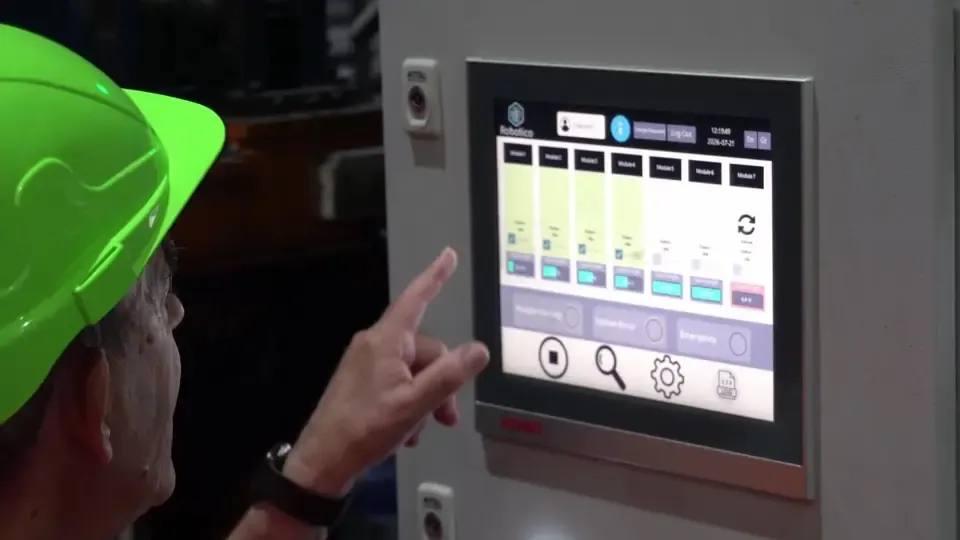
When the bundle changes, the cut length changes with it. The operator picks the configuration on the panel.
It checks itself
Sensors at the inlet and outlet confirm the line is there. If it is not, the head stops and tells the stacker.
The explanation in 90 seconds, with the machine at ELASTRON
CUSTOMER REFERENCE · ELASTRON
From manual to automatic, on three lines.
ELASTRON, a steel producer listed on the Athens Stock Exchange, has run LineFeeder since 2024. A second system followed in 2025 and a third in 2026. On each line: zero white rust, the bottleneck gone, and two people per shift out of the stacking zone. Each system paid for itself in under two years.
- 20241st system
- 20252nd system
- 20263rd system
“We have achieved optimal spacing between tubes, resulting in zero white-rust formation, and we have completely removed the line-speed bottleneck.”
“In just one year we have eliminated a monotonous, dangerous manual task, drastically improving workplace safety.”
Chief Technology Officer of ELASTRON at the time, case study, 2026
By hand and with LineFeeder
| Spacers by hand | LineFeeder | |
|---|---|---|
| People in the stacking zone | Two per shift | None |
| Placement | Varies with the operator | The same position on every row |
| Line speed | The stacker waits for people | The stacker sets the pace |
| Divider length | One length, the longest, for every row | Cut to the width of each row |
| White rust | A risk in every bundle | None on the lines at ELASTRON |
What does placing spacers by hand cost you?
Put in your own numbers. The values shown are an example.
Each system at ELASTRON paid for itself in under two years. Send us these three numbers and we will work out the payback for your line.
YOUR LINE
It fits the stacker you already run.
- Where it mounts
- On your existing stacker, in line with the tube mill.
- What a system is
- Four heads, a control cabinet, an operator panel and the software link to the stacker’s PLC.
- Installation
- During a planned maintenance stop.
- Divider
- Square-section nylon line. It does not absorb moisture and it does not slide.
- Positions
- One divider on each row, at as many points along the bundle as you specify.
- Change-over
- The operator selects the bundle configuration on the panel; the cut length follows.
- Pace
- Synchronised with the stacker’s PLC. It is never the bottleneck.
Where else it fits
Any line that stacks tubes or profiles and inserts dividers, sheets or corner protectors by hand.
For lines already running, we fit it ourselves. Internationally LineFeeder is also available through POMINI Long Rolling Mills.
QUESTIONS
What mills usually ask.
Does it work with my stacker?
LineFeeder is built to mount on existing stackers. Tell us the make and model and how your bundles are formed. After a questionnaire and one visit we tell you in writing whether it fits.
Will it slow the line?
No. The head works in step with the stacker through the PLC. At ELASTRON it removed the bottleneck that manual placement had created.
What happens if the line runs out or jams?
Sensors at the inlet and outlet detect that the line is missing. The head stops and signals the stacker, and the operator sees it on the panel.
What does it need to keep running?
Spools of nylon line and a few wear parts. We supply both.
How long is the line down for installation?
The system is installed during a planned maintenance stop.
Is the technology protected?
Yes. The mechanism is covered by Greek patent GR 1011084 and by international application PCT/GR2025/050040, published as WO 2026/154276.
Who stands behind it?
Robotico designs, builds, installs and supports LineFeeder. Powered by Tech Hive Labs.
NEXT STEP
Do you stack tubes or profiles?
Tell us which stacker you have and how the dividers go in today. In one visit we tell you whether LineFeeder fits your line and how fast it pays back.
A 30-minute call
You tell us the job and the number that bothers you.
Questionnaire and site visit
A solution and an indicative price in writing, within two weeks.
Proof of the hard part first
We prove it, then we build.
Installation and support
During a planned stop. Service is ours.
What to send us
- Make and model of the stacker
- Tube sizes and bundle shapes
- Shifts per day
- How the spacers are placed today